Traceability, repair and resale are turning luxury’s after-sales journey into an operational question for retailers.
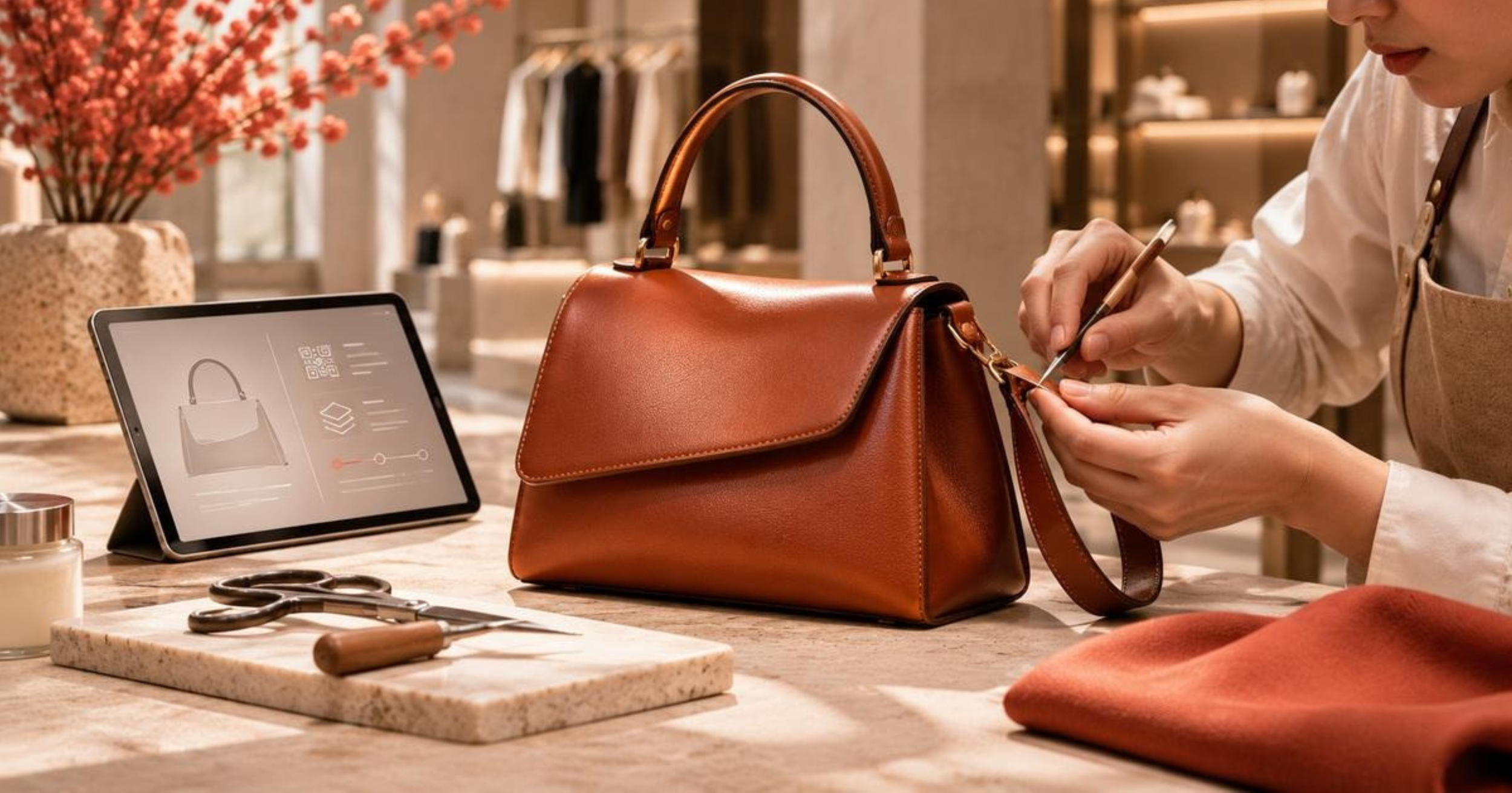
Featured image: conceptual luxury after-sales care with a digital record. Original editorial illustration, not a photograph of a Chalhoub–BEEAH service.
Luxury brands have long invested in controlling the customer experience, from product presentation and storytelling to the moment of purchase. What happens to a product afterwards, however, raises a different set of business questions.
As resale, repair and circular fashion gain attention, retailers face a challenge that goes beyond sustainability. Keeping products in circulation requires reliable information about their identity, condition and history, as well as the infrastructure to manage them across different owners and markets.
A September 2026 agreement between Chalhoub Group and UAE-based sustainability company BEEAH offers a regional example. The two organisations signed a memorandum of understanding to explore circular-economy initiatives, including take-back solutions, reverse logistics, digital track-and-trace and AI-enabled waste optimisation.
While the agreement does not represent an operational circular luxury platform, it highlights the systems retailers may need to develop if they want to extend their involvement beyond the first sale.
The technology behind circular luxury
Resale platforms have made second-hand luxury more accessible, but the processes behind them remain complex. Products need to be identified, authenticated, assessed and directed towards repair, resale or material recovery.
Digital product identities and traceability systems could help connect these processes. A product identifier, for example, could link information about materials and care requirements with subsequent repair or resale records. AI-assisted tools may also support condition assessment and sorting, although their reliability and commercial value would need to be demonstrated.
Digital product passports are particularly relevant. They offer a way to make product information available throughout an item's lifecycle, potentially supporting authentication, repair and resale.
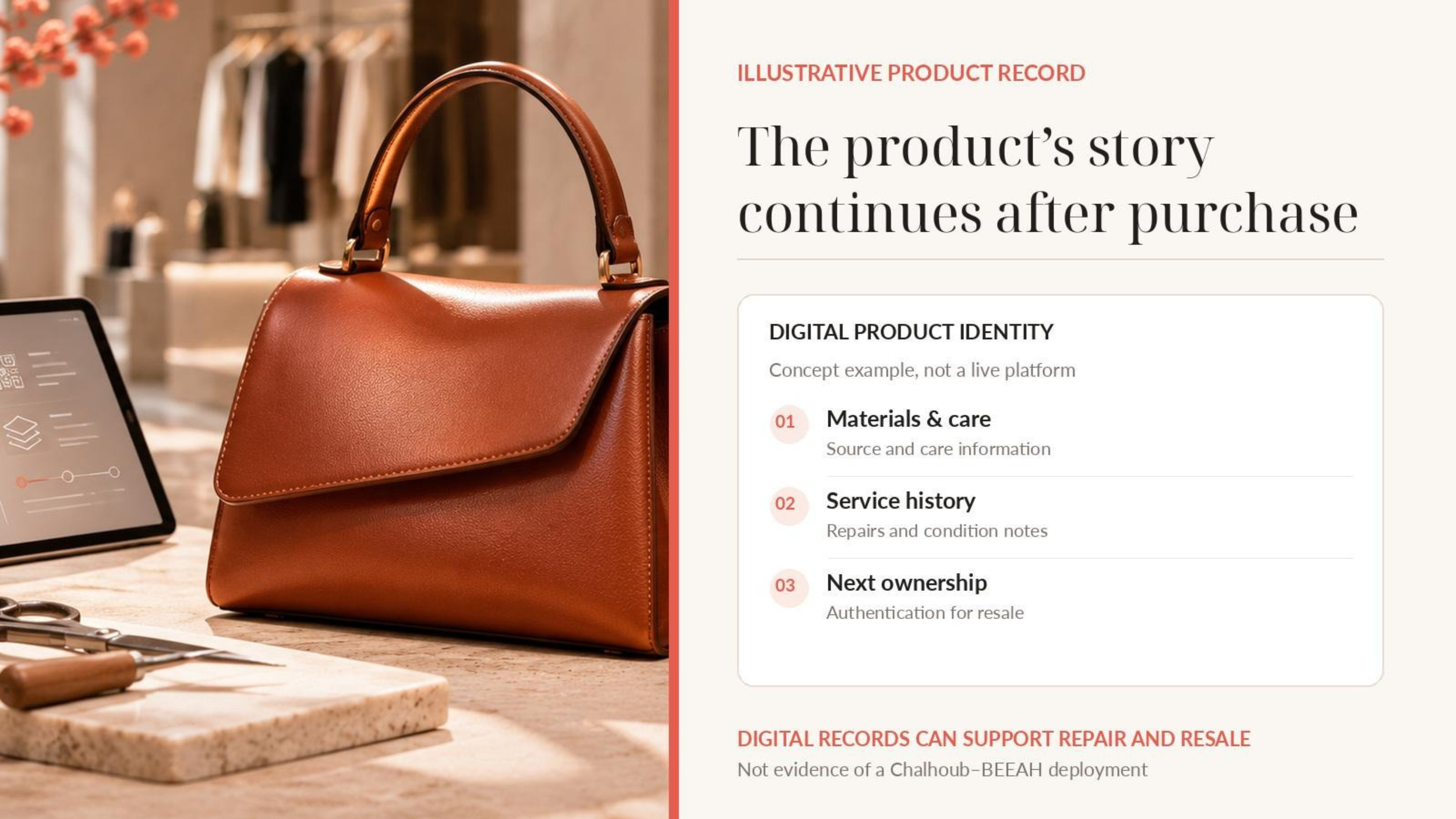
In-post visual: an illustrative digital product identity, showing information that could support authentication, repairs and resale. Not a live platform.
However, technology is only one part of the equation. Retailers also need physical collection networks, logistics partners, repair capabilities and clear rules governing access to product and customer information.
The Ellen MacArthur Foundation's 2026 research on resale and repair highlights the economic challenges associated with collection, sorting and labour-intensive services. Although the report focuses on policy developments in Canada, the EU and the US, the underlying operational challenges are also relevant to retailers in the GCC.
What this means for the GCC
The GCC presents an interesting environment for developing circular luxury services. Major retail groups operate multiple international brands across stores, e-commerce channels and markets, creating opportunities to coordinate services that individual brands might otherwise have to develop separately.
A customer could purchase a handbag in Dubai, have it repaired in Riyadh and eventually sell it through a resale platform. Supporting that journey would require reliable product information, authentication capabilities and coordination between different service providers.
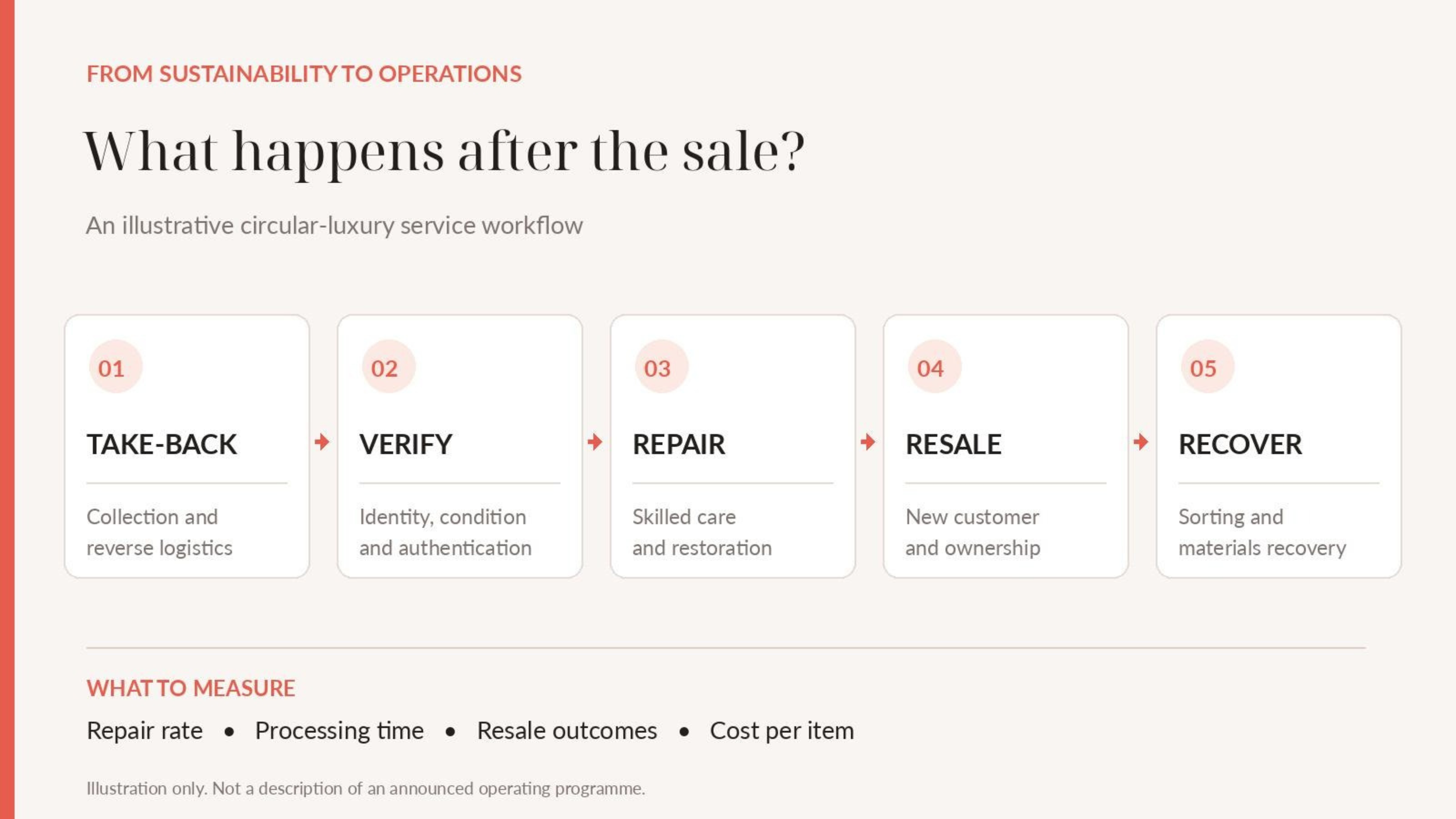
In-post visual: a possible circular-services workflow. This is an illustrative process, not an announced or measured Chalhoub–BEEAH programme.
This also raises questions about the commercial relationship with the customer. When a luxury product changes hands, who manages its digital identity? Who verifies its authenticity? And does the original brand remain involved in its subsequent lifecycle, or does that relationship move entirely to a third-party platform?
For luxury retailers, circular services could create additional opportunities for customer engagement and after-sales revenue. Yet their commercial viability will depend on processing costs, customer demand and the proportion of products that can successfully be repaired or resold.
The Chalhoub–BEEAH collaboration points towards the possibility of connecting retail networks with specialised sustainability and logistics infrastructure. Whether this develops into shared services across brands remains to be seen.
From sustainability ambition to business model
For retailers considering circular initiatives, the immediate priority may be to understand what happens to products after they are collected.
Collection volumes alone reveal little about whether a programme is successful. Repair rates, resale outcomes, processing times and costs provide a more useful picture. Environmental benefits also need to be substantiated rather than assumed.
The larger opportunity lies in connecting these operational capabilities with the customer experience. A reliable repair or resale service can potentially extend a product's useful life while giving customers another reason to engage with the retailer.
For the GCC luxury industry, circularity may therefore become as much a question of technology, infrastructure and commercial strategy as environmental responsibility.
Luxury brands have spent decades managing how their products are sold. The next question is how much control they want to retain once those products change hands.