OpenAI's latest announcements bring AI-mediated shopping closer to reality. With ChatGPT Wallet and Businesses in ChatGPT, the platform is moving beyond product discovery towards transactions. For fashion and luxury brands in the GCC, the implications extend well beyond another digital sales channel.

From Product Discovery to Purchase
Until recently, the conversation around AI and shopping focused largely on discovery. Consumers could ask ChatGPT to recommend a handbag, compare products or identify brands that matched their preferences. The final purchase still required them to navigate to a retailer's website and complete checkout.
That distinction is beginning to disappear.
In November 2026, OpenAI introduced ChatGPT Wallet, enabling eligible users to complete purchases through AI agents. Developed with payment partners including American Express, Chase, Mastercard and Visa, the wallet uses tokenised payment credentials and requires customers to approve transactions through biometric authentication.
For now, purchases require explicit approval, and availability is limited to eligible users in the United States. But the direction is clear: AI is evolving from a recommendation tool into an interface through which consumers can transact.
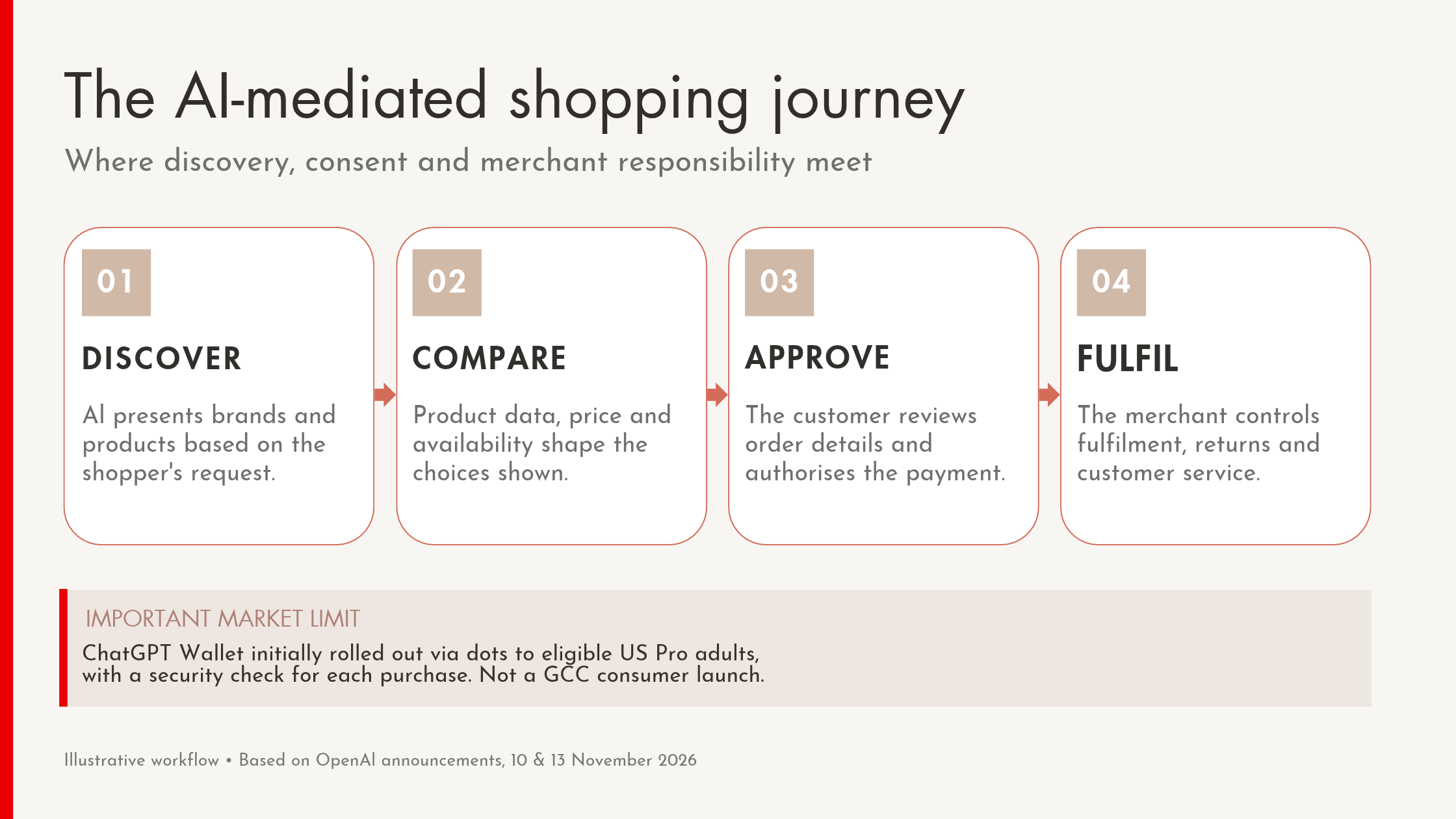
For fashion and luxury brands, this raises a fundamental question. What happens when the customer journey no longer begins, or necessarily takes place, on a brand's own digital channels?
Businesses in ChatGPT: A New Point of Visibility
Just days before the wallet announcement, OpenAI introduced Businesses in ChatGPT, allowing eligible companies to claim their business profiles, manage information and improve how their products and services are represented within ChatGPT.
This development may prove particularly relevant for GCC brands.
As consumers turn to conversational AI for shopping recommendations, the accuracy and accessibility of brand information become commercially important. Product descriptions, pricing, availability and brand identity are no longer relevant only to traditional search engines or e-commerce platforms. They also influence how AI systems interpret and present a business.
For regional fashion labels, independent designers and emerging luxury brands, this creates an opportunity to establish a stronger presence in AI-mediated discovery without relying exclusively on traditional advertising or established retail marketplaces.
However, claiming a business profile should not be confused with guaranteeing visibility. AI recommendations depend on multiple factors, and brands will still need reliable, structured product information and a consistent digital presence.
Who Controls the Customer Relationship?
The more consequential question is not whether AI can complete a purchase. It is who influences the decisions leading to that purchase.
Luxury brands have invested heavily in controlling the customer experience, from visual storytelling and personalised service to carefully designed boutiques and digital environments.
An AI agent introduces a different intermediary.
A consumer might ask for a leather work bag within a particular budget, suitable for travel and available for delivery in Dubai. The agent could compare several brands, assess practical characteristics and eventually complete the transaction.
The consumer may never explore the brand's website, encounter its campaign imagery or engage with its carefully curated narrative.

OpenAI says merchants retain control over pricing, fulfilment, returns and their direct customer relationships. Yet retaining the transaction does not necessarily mean retaining influence over the entire purchasing journey.
For luxury brands, where desirability is built through more than product specifications, this distinction matters.
What GCC Brands Should Consider Now
Although ChatGPT Wallet is not yet available to consumers in the GCC, the announcements provide a useful indication of where digital commerce may be heading.
Brands should begin examining how accurately their products are represented in AI-generated responses, whether their product information can be understood by AI systems and how their existing commerce infrastructure could support agent-initiated transactions.
Businesses in ChatGPT adds another consideration: who within an organisation is responsible for managing its presence across emerging AI interfaces?
For regional retailers operating across multiple markets, languages and currencies, consistency will be particularly important. Product availability in Dubai may differ from Riyadh, while pricing, delivery conditions and customer expectations vary across the region.
There is also a strategic choice to make. Brands can treat AI as another distribution channel, or consider how to preserve differentiation and customer engagement when purchasing decisions are increasingly mediated by intelligent systems.
The Next Commerce Interface
ChatGPT Wallet and Businesses in ChatGPT represent two connected developments: businesses becoming more visible within AI environments, and consumers gaining the ability to transact through them.
Neither announcement means that autonomous shopping has become mainstream. The technology remains at an early stage, and adoption will depend on consumer trust, merchant participation and regional availability.
Nevertheless, the implications for fashion and luxury are already worth examining.
The next phase of digital commerce may not simply be about attracting consumers to a website. It may be about ensuring that a brand remains visible, relevant and desirable when an AI agent helps decide what to buy.