
A practical framework for brands navigating Universal Commerce Protocol (UCP)

This article is for general informational and educational purposes only and does not constitute financial, legal, investment or any other form of advice.
Google’s announcement of the Universal Commerce Protocol (UCP) has been framed as a technical update for AI agents. While the name sounds technical, the idea behind it is straightforward. UCP is about what happens when AI stops helping people research products and starts helping them buy them. At its core, this will be a big shift from how e-commerce operates today.
If that feels abstract, think about how we shop today. We search, click through websites, compare options, check delivery and returns, maybe abandon the cart, and start again somewhere else. It’s fragmented and time-consuming, even when the product itself is simple.
UCP points to a different model. One where shopping becomes conversational.
What Google announced UCP is an open standard that lets AI agents “talk” to retailers, marketplaces, and payment providers in a consistent way. So instead of every brand building one-off integrations for every agent, UCP aims to create a shared language for shopping actions across the journey, including discovery, buying, and even post-purchase support.
The standard was co-developed together with Shopify, Walmart, Target and Etsy. In its announcement, Google said: “To start, UCP will soon power a new checkout feature on eligible Google product listings in AI Mode in Search and the Gemini app, allowing shoppers to check out from eligible U.S. retailers right as they’re researching on Google”.
Below, we try to make sense of what this might mean in simple(ish) terms and how brands should think about it.
From browsing to asking
Today, most online shopping follows the same pattern: search, compare, check terms, and purchase. In an AI-led flow, a customer doesn’t need to open multiple tabs. They can simply ask:
“I’m looking for a white summer dress, under $300, in size 8, with fast delivery and easy returns.”
An AI assistant/agent then does the work in the background: scanning retailers, checking availability, comparing policies, narrowing the shortlist and, increasingly, completing the checkout.
UCP is the framework that allows this to happen at scale. It gives AI systems, retailers and payment providers a shared way to communicate.
What UCP actually does
Think of it as a shared rulebook that allows AI assistants to interact with thousands of retailers without custom integrations each time. Essentially, it lets AI agents:
Understand product catalogues
Check pricing and inventory
Confirm delivery and return policies
Initiate payment using stored credentials
Although early rollouts will be US-focused, the implications are already worth understanding even for markets where this isn’t live yet.
Why discoverability changes
Currently, discoverability is largely about visibility. A customer can find your brand via search, ads, social media or a marketplace.
In an AI-mediated world, the AI assistant (i.e. Google AI Mode, Gemini) becomes an intermediary, deciding which products are worth showing to the customer in the first place.
That means brands are no longer just competing for clicks. They’re competing to be understood and trusted by an AI system.
If an assistant can’t clearly assess your product, your pricing, your delivery promise or your return policy, it’s less likely to recommend you at all. In other words, discoverability becomes less about who shouts loudest and more about who is easiest to evaluate.
This is where things get interesting for brands. In an AI-led flow, discoverability still starts with awareness (ads and branding still matter), but selection happens inside the AI interface.
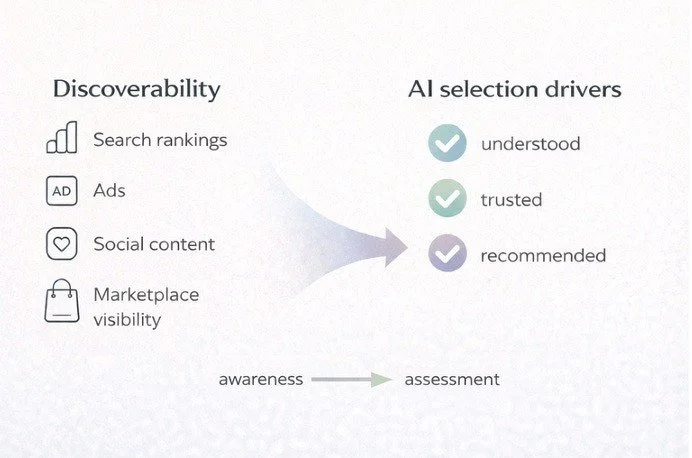
In simple terms, if an AI can’t confidently explain your product, your policies, or your availability, it’s less likely to surface you as an option.
The new “storefront” (is not a homepage)
One of the biggest shifts is where the buying decision happens.
Traditionally, the product detail page has been the moment of truth. That’s where the customer looks at images, reads descriptions, checks reviews and decides whether to buy.
With AI agents, that decision may be made before the customer ever visits your site. The AI assistant evaluates the brand using structured information provided by the merchant: product attributes (materials, sizing, fit notes), availability, return policies, reviews and reputation signals.
The merchant’s data layer becomes the storefront.
Your homepage still exists. Brand storytelling still matters. But it’s no longer the only place where trust is built. Increasingly, trust is established upstream, inside the AI interface. This means that structured, accurate information becomes just as important as visuals.
What brands can do now (without overhauling everything)
Preparing for this shift doesn’t mean rebuilding your tech stack or rushing into AI pilots. Most of the work is operational and strategic (if not boring).
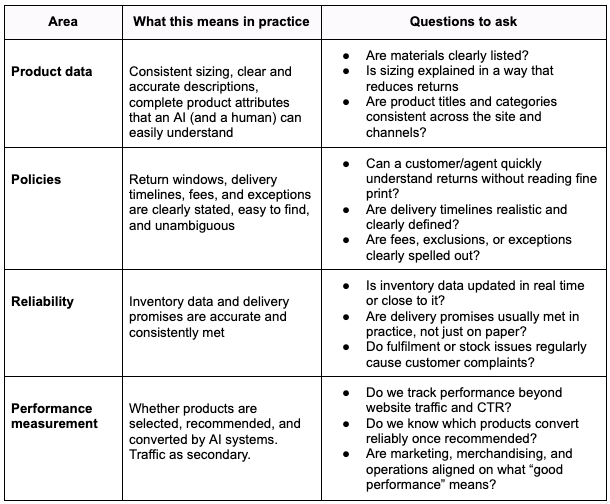
It starts with product data. Clear, consistent descriptions, accurate sizing information and well-defined attributes make it easier for AI systems to understand and compare your products. What feels like a content hygiene issue today can quickly become a discoverability issue tomorrow.
Policies matter just as much. Delivery timelines, return windows and exchange rules need to be easy to interpret, not buried in caveats. If an AI can’t confidently explain your policy to a customer, it may avoid recommending the product altogether.
Reliability also becomes visible. If inventory data is frequently wrong or delivery promises are missed, that history feeds back into how confidently an assistant recommends a brand. In an agent-led world, operational performance directly affects visibility.
Performance measurement shifts. Performance marketing doesn’t disappear, but its role evolves. Ads and brand activity still influence discovery, but conversion may happen inside an AI interface rather than on your site. That means performance should be measured not just by traffic, but by how often products make it into AI shortlists and complete purchases. This is a new mental model for many brands.
For fashion brands, this requires closer alignment between marketing, merchandising and operations. The experience the AI represents needs to match the experience the customer actually receives.
Put simply, preparing for agent-led commerce comes down to four areas brands already control:
What this means for the Middle East
While the initial rollout is US-focused, regions like the Middle East are structurally well-positioned for this shift. Mobile usage is high, digital payments are widely adopted, and e-commerce logistics continue to mature.
When agent-led commerce arrives locally, the brands that have done the groundwork will be easiest to surface and easiest to buy from. For regional brands, the opportunity isn’t to chase every new AI feature, but to prepare early. Clarity, consistency and reliability will matter far more than novelty.
That said, local nuances matter. Payment preferences, delivery infrastructure, language, and regulation all influence how quickly agent-led commerce will be adopted in the region.
The takeaway
UCP isn’t about replacing websites or removing choice. It’s about changing how decisions are made. In many ways, this feels familiar. Google didn’t invent SEO, but it ended up defining it. With agentic commerce, it appears to be doing something similar again.
As agentic commerce becomes the new normal, discoverability will increasingly be about being understandable and reliable. Brands that treat product data, policies, and customer experience as strategic assets will be best positioned for AI-led commerce.